What Buy Back Your Time Taught Me as a Virtual Assistant and Mom
“If your business depends on you, you don’t own a business, you have a job. And it’s the worst job in the world because you’re working for a lunatic!” — Michael E. Gerber
Recently, I finished reading Buy Back Your Time by Dan Martell. I read it through two different lenses, one as a virtual assistant and another as a small business owner.
I have to say, this is one of the best professional development books I’ve come across in a long time.
Throughout the book, Dan walks readers through the principles he uses to coach CEOs as they scale and grow to the next level. Topics range from auditing your workload and planning your week to outsourcing, building SOPs, and setting larger goals.
As a Virtual Assistant, a few points stood out to me most, especially in how I guide clients through onboarding and setting up support. I’ve been in this space for three years now, and I honestly wanted to jump out of my chair reading some of these chapters. They are the exact actions I walk my clients through when they are ready to pass off new tasks and put the right systems in place to support that growth.
So let’s do a quick recap.
Side note, I highly recommend grabbing a copy of this book from your favorite bookstore, as I will not give everything away here.
What the DRIP Matrix Reveals About When to Hire a Virtual Assistant
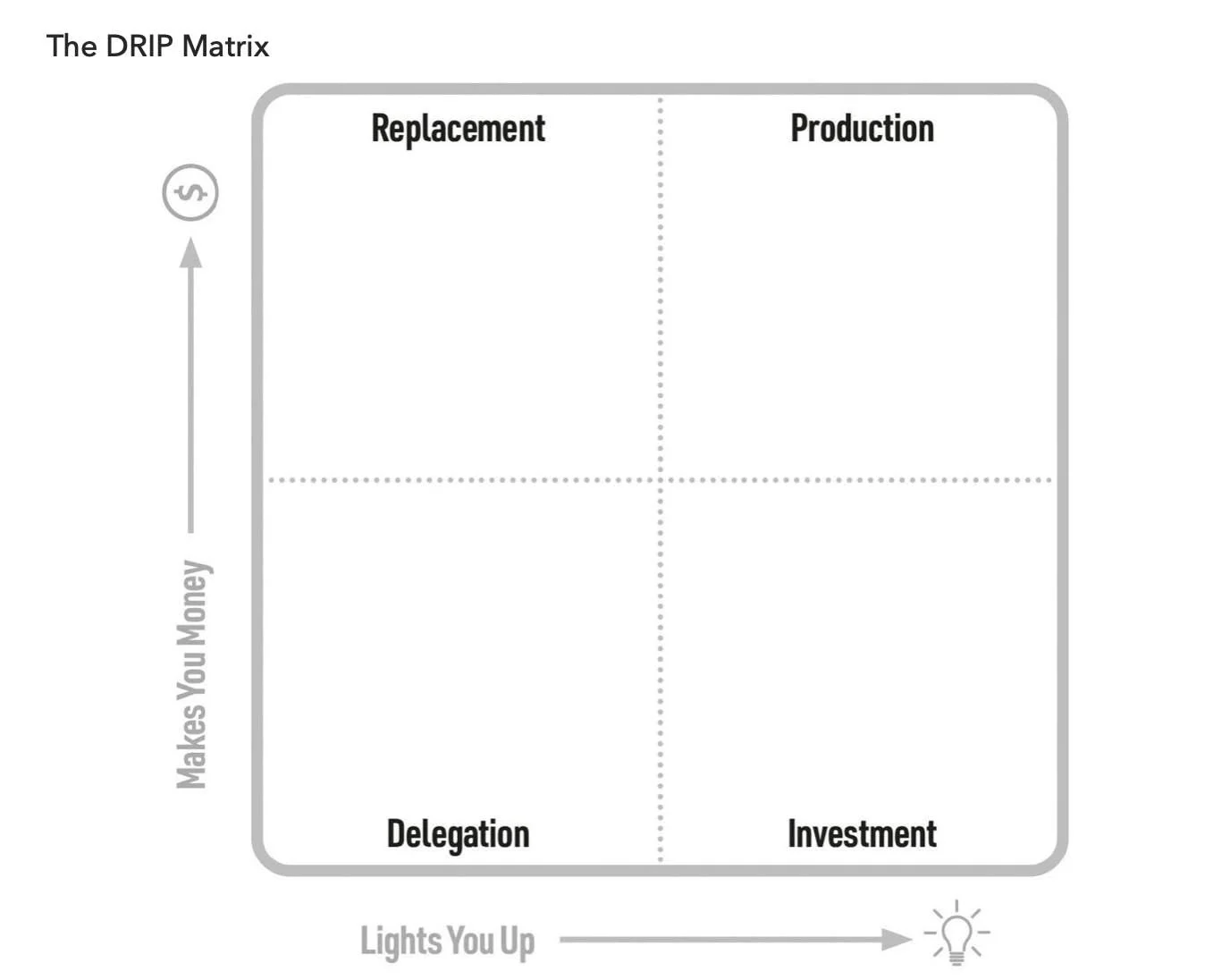
Could you imagine starting your day, reviewing your to do list, and actually feeling energized by everything on it?
That is the goal of Dan’s DRIP Matrix. It’s about identifying the tasks that truly light you up and creating space to spend more time there.
The DRIP Matrix helps you clearly see where your time and energy are going by auditing your tasks and categorizing them into four groups:
Replacement, Production, Delegation, or Investment.
If you are on the fence about outsourcing, this exercise alone can bring a lot of clarity, not just on if you should hire support, but what kind of support you need.
If we were working together, I would immediately focus on your delegation and replacement categories. These are typically the tasks that drain your energy but still need to get done.
For most business owners, things like email management and SOP organization naturally fall into these areas, and they are exactly where a virtual assistant or OBM can step in to give you your time back while keeping your business moving forward.
Preparing for Support: Why Most Business Owners Get Stuck
Over the past several years, one of my biggest responsibilities has been maintaining a company’s policies and procedures. Because of that, I understand both the impact of strong training and the time it takes to create it.
Dan’s approach to building SOPs, what he calls playbooks, is one of the most practical ways to get started, especially when preparing to onboard support.
He breaks it down into the 4 C’s:
The Camcorder Method
The Course
The Cadence
The Checklist
The Camcorder Method: The Easiest Way to Train and Delegate
This was easily my favorite concept in the book as a virtual assistant.
The Camcorder Method is incredibly simple. Open a screen recorder like Loom or even Zoom and walk through a task while explaining it out loud.
From there, have your new hire take that recording and turn it into a written SOP.
This approach does a few things really well. They see exactly how you complete the task, they actively process and document it, and they can identify gaps and ask better questions.
It also eliminates the need to repeat yourself or schedule multiple training calls for the same process.
It is a win-win, saving time while building stronger, more scalable systems.
Planning Ahead to Create More Freedom (Even in the Busy Seasons)
The final concept that stood out to me applies more to business owners directly, how you structure your time.
I work from home running my virtual assistant business, balance a full time 9 to 5, and raise two young boys alongside my very adventurous husband who loves to travel.
So yes, life often feels like a well played game of Tetris, constantly figuring out where the pieces fit.
Dan challenges readers to design their “Perfect Week” and take it even further with a “Preloaded Year.”
These quickly became some of my most highlighted sections, not just because I love a good planning session, but because they are immediately actionable.
Using the idea of a Preloaded Year and breaking it down into weekly and daily priorities has helped me create more rhythm in both my work and home life.
From knowing exactly when I am meal planning to mapping out major milestones across the year, this level of planning has given me clarity on what I can take on, where I need support, and how to stay present in what matters most.
We all have the same 24 hours, but as Dan shows, it is how we audit and protect those hours that defines our success.
Managing a 9 to 5, a business, and a busy family has taught me that the “perfect week” is not a myth, it is the result of intentional planning and smart delegation.
You Don’t Have to Do This Alone
As Dan Martell says, if your business depends on you, you have a job, not a business.
By using tools like the DRIP Matrix and the Camcorder Method, you can begin to shift from being the operator to truly becoming the owner.
You do not have to manage the “game of Tetris” alone.
If you are ready to step out of the day to day and start operating as the owner of your business, I would love to support you.
Click here to connect and let’s talk about how we can build the systems that give you your time back!